OptiValue Tek
Energy & Utilities Whitepaper
Partner-Level Digital Transformation
Industry Whitepaper

Energy & Utilities Digital Transformation

Building Intelligent, Resilient, and Sustainable Energy Ecosystems

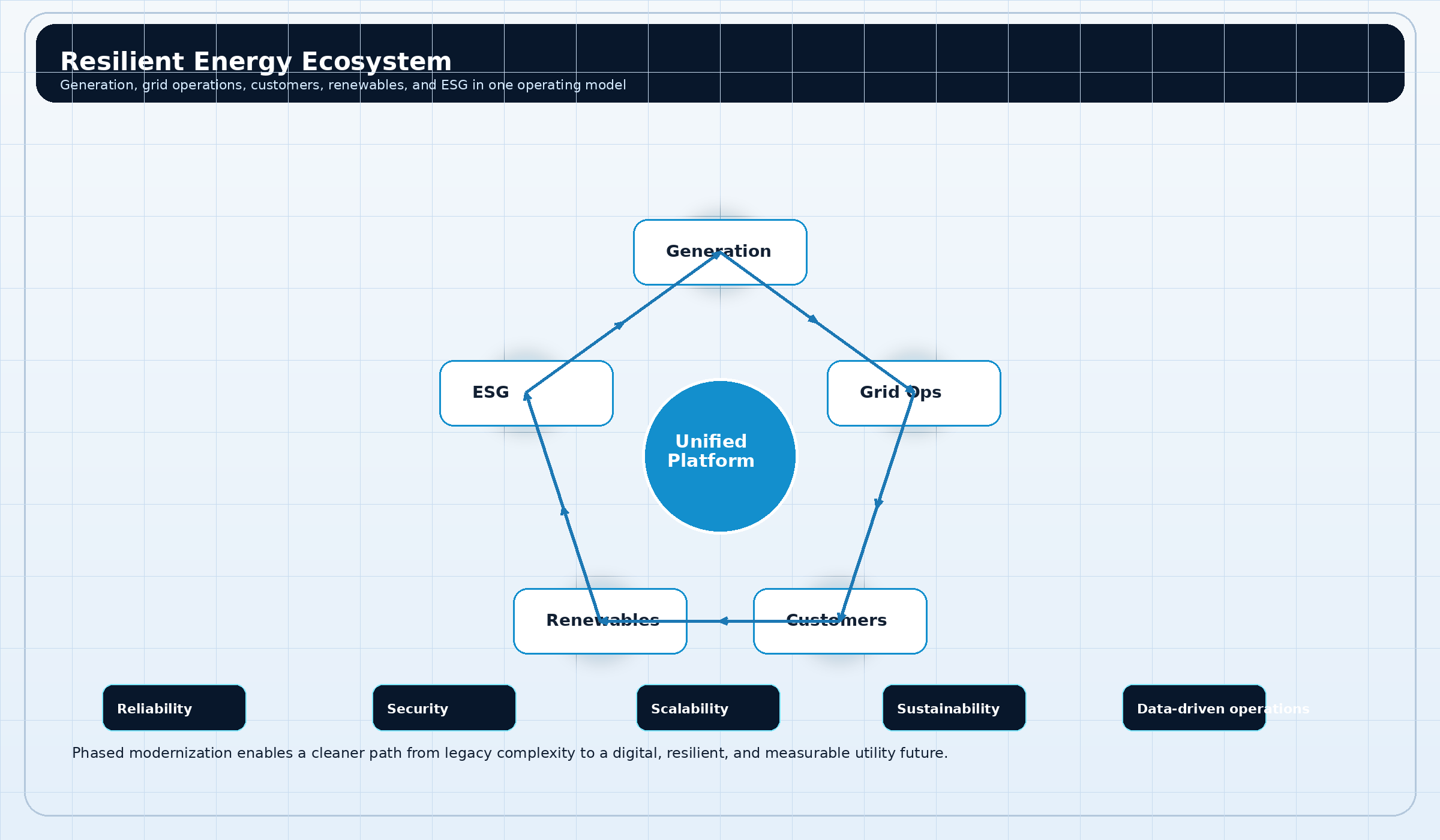
A strategic whitepaper for power generation, transmission and distribution, oil & gas, renewable energy, EV infrastructure, smart grid operators, and utility retailers seeking to modernize operations, improve reliability, and accelerate the energy transition through platform thinking, real-time data, and secure OT/IT convergence.

SAIDI / SAIFI
Reliability and outage performance as a board-level operating metric
Renewables %
Higher integration of solar, wind, hybrid and distributed resources
Outage Response
Faster detection, dispatch, isolation, restoration and customer communication
Asset Uptime
Predictive maintenance and improved utilization across the energy estate
Energy Loss
Lower technical and commercial losses through visibility and control
Service Activation
Faster customer onboarding, connection, and service provisioning
Ops Efficiency
Automation, orchestration, and reduced manual intervention
Cost / MW
Optimized capital and operating efficiency across the value chain
OptiValue Tek
Energy & Utilities Whitepaper
A4 Portrait | PDF Export Ready
Table of Contents

Contents

Structured for executive review, technical workshops, and board-level transformation planning
1. Cover Page01
2. Table of Contents02
3. Executive Summary03
4. Industry Context & Challenges04
5. Transformation Vision05
6. Technical Architecture06
7. Solution Building Blocks07
8. Implementation Approach08
9. Use Cases / Industry Scenarios09
10. Business Impact10
11. Why OptiValue Tek11
12. Engagement Model12
13. Conclusion & Next Steps13
Audience

Who this whitepaper is for

  • Utility executives balancing reliability, cost, and sustainability
  • Grid modernization leaders, CIOs, CTOs, and digital heads
  • OT, SCADA, and platform teams integrating field operations with cloud data
  • Transformation teams shaping DER, AMI, ESG, and energy analytics roadmaps
Positioning

What OptiValue Tek brings

OptiValue Tek’s company profile highlights application modernization, cloud solutions, API management, data engineering, cybersecurity, IoT, digital twin capability, DevOps, managed services, and reusable accelerators such as Smart Gateway, Convergent, JARVIS, Sentinel, and an analytics logging framework.

CloudIoTAPIDataDevOpsSecurity
OptiValue Tek
Section 3 | Executive Summary
Executive Summary

The energy transition needs a digital operating model

Reliability and decarbonization must improve together, not in trade-off

Energy and utilities organizations are under simultaneous pressure to decarbonize, stabilize the grid, modernize aging assets, improve customer experience, and defend critical infrastructure against cyber threats. Traditional operating models built around siloed OT, legacy billing, and periodic reporting can no longer keep pace with the speed, complexity, and volatility of modern energy systems.

Core market pressures

  • Decarbonization: renewable penetration is increasing variability, storage needs, and balancing complexity.
  • Reliability: aging infrastructure and load growth are raising outage risk and maintenance burden.
  • Regulation: utilities face more reporting, compliance, audit, and governance expectations.
  • Efficiency: leaders must lower cost per MW, reduce losses, and improve asset utilization.
  • Resilience: cyber, climate, and supply-chain shocks require more adaptive and observable systems.
Intelligent grid
Real-time situational awareness, self-healing operations, and event-driven control.
Secure OT/IT
Zero-trust identity, segmentation, monitoring, and compliance for critical infrastructure.
Sustainable growth
ESG, renewables, and distributed energy orchestration built into the platform model.
The central thesis: utilities do not need isolated point solutions; they need a resilient energy platform that connects assets, field operations, customers, data, and security under one coherent architecture.
OptiValue Tek
Section 4 | Industry Context & Challenges
Industry Context

Why transformation is urgent in Energy & Utilities

Legacy operations, distributed assets, and regulatory complexity are converging

What is breaking in the traditional model

  • Legacy grid infrastructure was not designed for high renewable penetration or bidirectional power flow.
  • Distributed energy resources and microgrids introduce orchestration complexity across many control points.
  • SCADA, telemetry, meter, customer, asset, and finance systems remain siloed and inconsistently governed.
  • Field crews often lack a single operational view of assets, tickets, weather, and outage events.
  • Manual reporting and spreadsheet-driven compliance create operational drag and audit risk.

Risk landscape

  • Cybersecurity: critical infrastructure is exposed through OT/IT convergence and third-party integrations.
  • Reliability: outage response, restoration, and switching require better observability and automation.
  • Losses: energy theft, technical losses, and meter exceptions reduce economic performance.
  • Forecasting: demand volatility and renewable intermittency complicate planning and dispatch.
  • Workforce: operational knowledge is fragmented across retiring teams and local practices.

Legacy grid

Ageing plants, substations, and distribution assets need condition-based maintenance and more intelligent asset lifecycle management.

Renewable variability

Solar, wind, and hybrid portfolios need forecasting, balancing, and grid stabilization support.

Customer expectations

Customers expect digital onboarding, service transparency, self-service, and accurate outage notifications.

A modern utility must operate like a data platform with safety-grade controls: measurable, observable, secure, and automation-ready.
OptiValue Tek
Section 5 | Transformation Vision
Transformation Vision

The future-state energy platform

One operational fabric across assets, data, control, and customer experience

Target operating model

Sense
Meters, sensors, SCADA, drones, and edge devices generate trustworthy telemetry.
Decide
Streaming analytics and AI translate events into actions and alerts.
Orchestrate
Control systems and APIs coordinate field, grid, and customer processes.
Improve
Continuous learning improves resilience, efficiency, and sustainability.

The right target state is not a single application. It is a platform of connected capabilities that can evolve with regulations, asset classes, and market structures.

Digital grid operations

Real-time switching, event correlation, outage intelligence, and restoration optimization.

Energy intelligence

Data products for load, generation, asset health, customer, and ESG reporting.

Secure automation

Policy-based controls, identity-centric access, and DevSecOps pipelines for regulated environments.

OptiValue Tek
Section 6 | Technical Architecture
Technical Architecture

Reference architecture for a digital-first utility

Designed for low latency, resilience, observability, and compliance
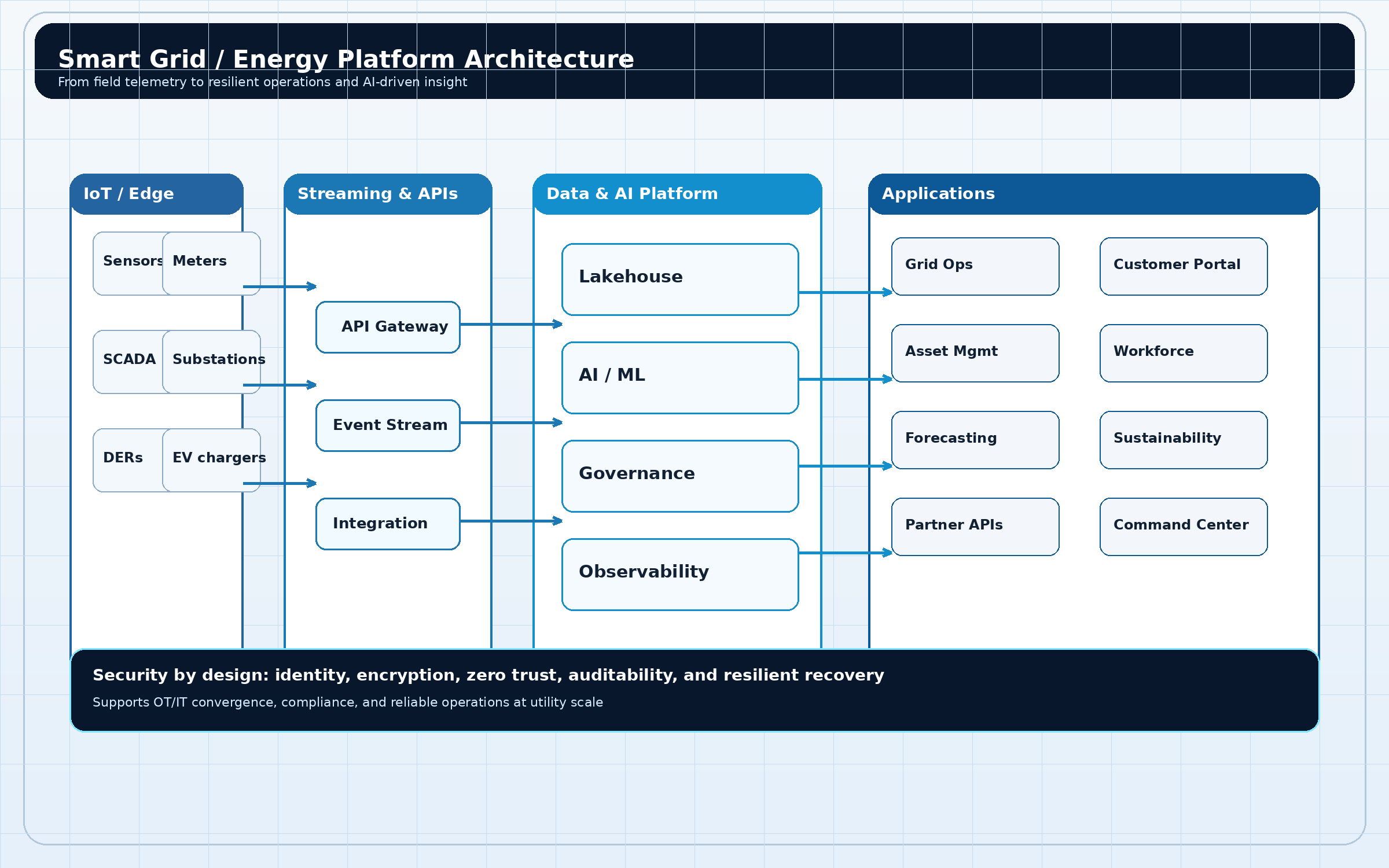
Reference Architecture for Digital Utility

Architecture layers

  • IoT / edge layer: sensors, meters, SCADA endpoints, substations, switchgear, and field devices.
  • Edge-to-cloud pipelines: secure telemetry, transformation, buffering, and store-and-forward.
  • API gateway: standardized exposure for grid services, customer journeys, and partner integrations.
  • Microservices: domain-aligned services for asset, outage, meter, billing, and DER operations.
  • Event-driven grid operations: publish/subscribe architecture for alarms, exceptions, and state changes.
  • Lakehouse: unified analytics foundation for historical, operational, and forecasting workloads.
  • AI/ML: predictive maintenance, load forecasting, anomaly detection, and decision support.
  • Observability: distributed logs, metrics, tracing, and operational dashboards.
  • Cybersecurity: zero trust, segmentation, identity, encryption, and continuous policy enforcement.
  • CI/CD: controlled release engineering for regulated utility workloads.
The architecture must support both deterministic operational systems and analytic workloads without compromising safety or uptime.
This visual represents the target-state integration of field assets with intelligent cloud platforms.
OptiValue Tek
Section 7 | Solution Building Blocks
Building Blocks

Composable capabilities that accelerate modernization

Each building block should be independently adoptable and integration-ready

Smart grid platforms

Core

Grid visibility, state estimation, switching support, outage intelligence, and automation orchestration.

IoT / edge computing

Edge

Telemetry ingestion, device management, protocol translation, and local resilience for substations and assets.

Asset management systems

EAM

Condition monitoring, work planning, lifecycle optimization, and maintenance prioritization.

Outage management systems

OMS

Event correlation, crew dispatch, restoration workflows, and customer impact analysis.

Energy analytics platforms

Data

Load, generation, loss, asset, and customer analytics with trusted enterprise reporting.

Customer digital platforms

CX

Self-service portals, onboarding, service activation, notifications, and billing engagement.

Cybersecurity solutions

Secure

OT/IT zero trust, identity, monitoring, vulnerability control, and incident response workflows.

DevOps for utilities

Change

Governed CI/CD, infrastructure as code, release control, and environment standardization.

AI/ML enablement

AI

Forecasting, anomaly detection, predictive maintenance, and optimization models for energy operations.

Illustrative cross-capability dependencies

  • AMI data feeds customer, billing, loss analysis, and theft detection.
  • Asset telemetry informs predictive maintenance and work order prioritization.
  • DER telemetry supports grid balancing, market participation, and resilience.
  • Cyber controls must be embedded in every layer, not added as an afterthought.

Key design principle

Use platform components to reduce duplication, enforce governance, and make each domain product measurable, secure, and reusable across the enterprise.

OptiValue Tek
Section 8 | Implementation Approach
Implementation

Phased transformation roadmap

Build confidence early, modernize safely, and scale without disrupting grid operations
1

Discover

Assess grid maturity, asset landscape, data quality, OT/IT boundaries, cyber posture, and business priorities.

2

Design

Define target architecture, operating model, platform choices, governance, and roadmap sequencing.

3

Build

Develop core platforms, data pipelines, integrations, security controls, and automation patterns.

4

Migrate

Modernize legacy services and move selected workloads with coexistence patterns and cutover controls.

5

Stabilize

Harden reliability, tune performance, validate resilience, and formalize operational playbooks.

6

Optimize

Improve cost, performance, resilience, and automation using telemetry and continuous feedback loops.

7

Scale

Extend to renewables, DER, advanced analytics, ESG, and multi-region or multi-utility expansion.

Phase 1
Maturity assessment, priority use cases, and measurable baseline.
Phase 2
Architecture and roadmap, with risk, governance, and business case.
Phase 3
Pilot build for selected plants, feeders, or customer journeys.
Phase 4
Legacy coexistence, data migration, and controlled cutovers.
Phase 5
Operational hardening, runbooks, and reliability engineering.
Phase 6
Automation, performance tuning, and continuous improvement.
Phase 7
Enterprise scaling across regions, assets, and business lines.

Controls that matter during implementation

  • Change windows aligned to operational and maintenance cycles
  • Rollback plans and cutover rehearsals
  • Testing for reliability, security, and load scenarios
  • Audit trails, approvals, and operational sign-offs

Recommended delivery pattern

Start with one high-value, low-regret domain such as outage visibility, AMI analytics, or asset prediction, then expand through reusable services and standards.

OptiValue Tek
Section 9 | Use Cases / Industry Scenarios
Use Cases

Representative scenarios for Energy & Utilities

Each use case includes business need, technical approach, value, and risk coverage

Smart grid implementation

Grid

Need: real-time visibility, switching support, and reliability improvement.

Approach: SCADA integration, event streaming, outage orchestration, and control dashboards.

Value: faster restoration, better coordination, and lower manual intervention.

Risks addressed: outage duration, operating errors, and fragmented operational views.

Renewable energy integration

RE

Need: manage intermittency and balance distributed generation.

Approach: forecasting models, DER orchestration, and dispatch-aware analytics.

Value: greater renewable penetration and stable grid behavior.

Risks addressed: variability, curtailment, and dispatch imbalance.

Predictive maintenance for assets

Asset

Need: reduce unplanned failure of transformers, turbines, pumps, and switchgear.

Approach: edge telemetry, digital twins, anomaly detection, and work order integration.

Value: fewer outages, better asset life, and optimized maintenance spend.

Risks addressed: catastrophic failure, safety incidents, and expensive emergency repairs.

Real-time outage management

OMS

Need: detect outages quickly and improve customer communication.

Approach: event correlation, field mobility, restoration workflow, and customer notifications.

Value: reduced outage duration and higher service satisfaction.

Risks addressed: poor situational awareness and inconsistent restoration actions.

AMI and theft analytics

Meter

Need: improve billing accuracy, loss detection, and load insight.

Approach: smart meter ingestion, exception detection, and revenue protection workflows.

Value: lower non-technical losses and better customer and revenue visibility.

Risks addressed: theft, meter anomalies, and reconciliation issues.

EV charging infrastructure platform

EV

Need: coordinate charging, tariffs, availability, and grid impact.

Approach: API-led platform, load management, occupancy data, and billing integration.

Value: scalable EV adoption with controlled grid impact.

Risks addressed: demand spikes, user friction, and fragmented operator experiences.

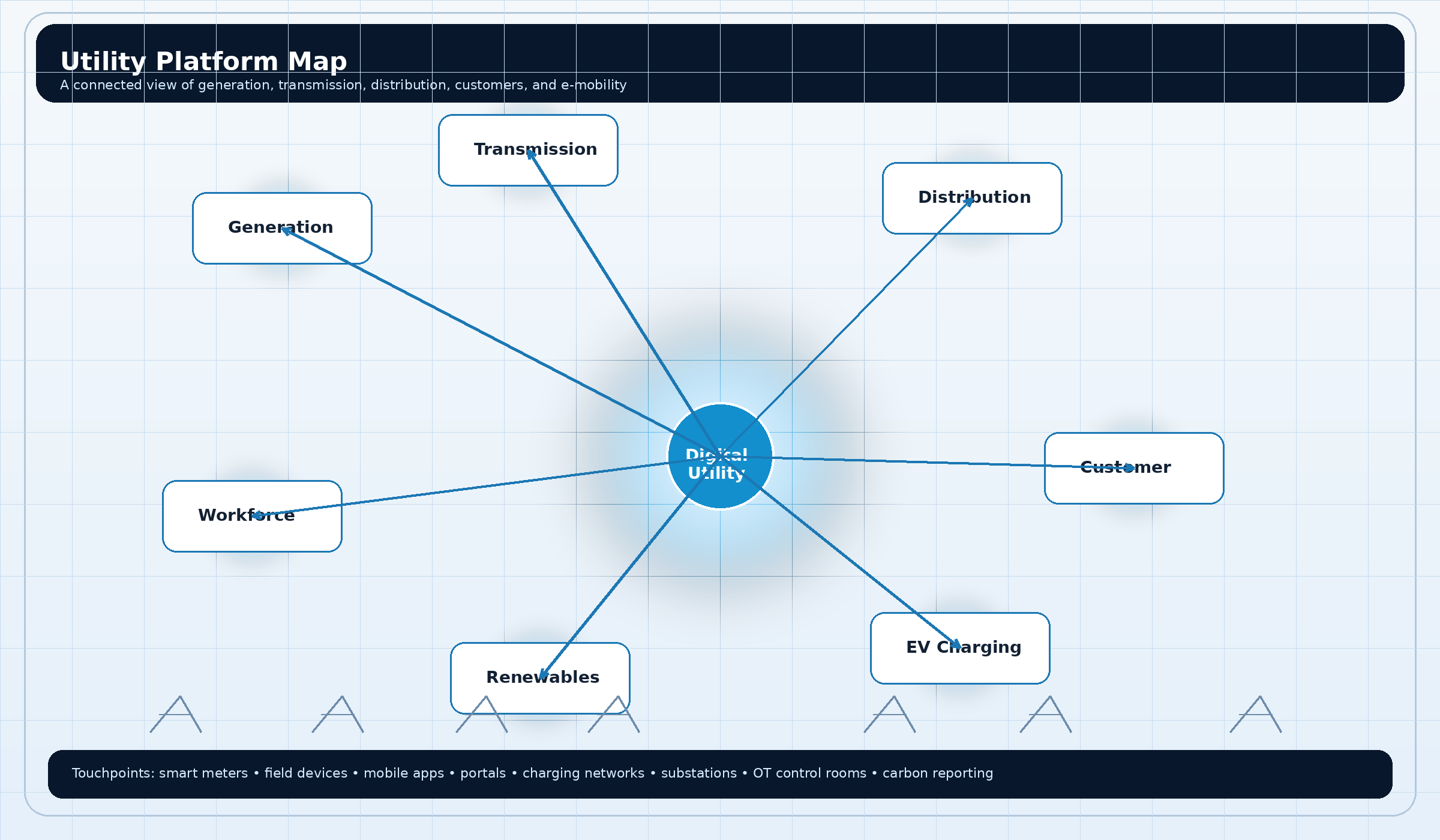
Utility Value Chain Mapping
OptiValue Tek
Section 10 | Business Impact
Business Impact

Value outcomes that matter to leadership

Results should be measurable, operationally credible, and financially defensible

Indicative impact areas

OutcomeHow it improves
Reduced outagesBetter visibility, event correlation, faster dispatch, and smarter restoration.
Improved asset utilizationCondition monitoring and predictive maintenance increase effective uptime.
Reduced energy lossAMI analytics, exception handling, and revenue protection reduce leakage.
Faster outage recoveryOMS, crew coordination, and automation compress restore time.
Improved forecasting accuracyAI/ML supports load, generation, and demand planning.
Lower operating costAutomation, standardization, and cloud economics reduce manual effort.
Increased renewable integrationForecasting and orchestration enable higher penetrations with control.
Better complianceTraceability, reporting, and security controls strengthen governance.
Outage response
Lower minutes to detect, notify, isolate, and restore.
Forecast quality
Higher accuracy for demand, renewable generation, and asset failure probability.
Operating margin
Reduced loss, cost, and effort improves economic performance.
OptiValue Tek
Section 11 | Why OptiValue Tek
Why OptiValue Tek

Trusted partner for energy platform engineering

Engineering depth, integration maturity, and reusable accelerators

Relevant strengths from the company profile

  • Deep experience in application modernization, cloud solutions, API management, and data engineering.
  • Capabilities in cybersecurity, IoT, digital twins, DevOps, SRE, and managed services.
  • Reusable accelerators and frameworks that reduce delivery time and improve governance.
  • Cross-domain execution across telecom, banking, energy, and enterprise modernization programs.

Accelerators that matter in utility modernization

  • Smart Gateway: governed API exposure for grid and customer services
  • Convergent: microservices framework for fast, standardised service delivery
  • JARVIS: service repository and dependency intelligence
  • Sentinel: workload-centric Kubernetes management and cost control
  • Analytics Framework: consistent, compliant telemetry and insight layer
  • DevOps pipelines: automation with built-in quality and security controls

Grid modernization expertise

Architecture-led approach for utility operations, asset, data, and customer domains.

IoT + cloud integration

Secure edge-to-cloud solutions designed for telemetry, orchestration, and analytics.

Cybersecurity for utilities

Identity, segmentation, monitoring, and resilience for OT and IT environments.

OptiValue Tek
Section 12 | Engagement Model
Engagement Model

How OptiValue Tek can engage

Flexible entry points from advisory through managed optimization

Engagement options

  • Advisory: transformation roadmap, maturity assessment, target architecture, and business case.
  • Pilot / MVP: one high-value use case such as smart grid visibility, AMI analytics, or predictive maintenance.
  • Platform engineering: build core integration, data, security, and orchestration layers.
  • OT/IT integration: bridge plant, grid, field, and enterprise systems safely.
  • Managed services: operate, monitor, and improve the platform with reliability discipline.
  • Governance & compliance: security, audit, data policy, and change governance.
  • Continuous optimization: performance tuning, cost reduction, and AI-driven improvements.

Recommended engagement sequence

1. Assess current maturity and prioritize value streams.

2. Design the target architecture and control model.

3. Build and validate a high-impact pilot.

4. Scale through reusable platforms and governance.

5. Operate with observability, resilience, and continuous optimization.

What success looks like

  • Fewer outages and faster restoration
  • Better asset health and utilization
  • Higher renewable integration with control
  • Lower operating costs and stronger compliance

Commercial model options

  • Fixed-scope advisory
  • Pilot with success criteria
  • Platform engineering squad
  • Managed services and optimization retainer
OptiValue Tek
Section 13 | Conclusion & Next Steps
Conclusion

Digital grid transformation is the foundation of energy transition

Resilience, sustainability, and intelligence must be engineered together

Next steps

Run a transformation workshop to align business priorities, target architecture, and implementation sequencing.
Identify one or two high-value pilots that can prove measurable value in 90–120 days.
Build a phased roadmap covering people, process, data, technology, governance, and operating model change.
Intelligent Energy Ecosystem Visualization