Telecom Digital Transformation
Scaling the Next-Gen Connectivity Landscape
Whitepaper on Modernizing BSS/OSS Systems, Cloud-Native Architecture, and AI-Driven Operations for Communication Service Providers.

Whitepaper on Modernizing BSS/OSS Systems, Cloud-Native Architecture, and AI-Driven Operations for Communication Service Providers.
The global telecommunications sector is at a critical inflection point. As 5G penetration increases, the traditional Communication Service Provider (CSP) model is evolving into a Digital Service Provider (DSP) model. However, legacy infrastructures—characterized by monolithic BSS/OSS stacks and fragmented data silos—are hindering this evolution.
This whitepaper outlines OptiValue Tek’s strategic framework for telecom modernization. By leveraging cloud-native microservices, automated CI/CD pipelines, and AI-driven intelligence, we enable CSPs to reduce time-to-market by 80% and operational costs by up to 60%.
The telecom industry faces a "perfect storm" of high capital expenditure (5G rollout) and stagnating ARPU (Average Revenue Per User). Success now depends on operational efficiency and the ability to launch new digital services weekly, not yearly.
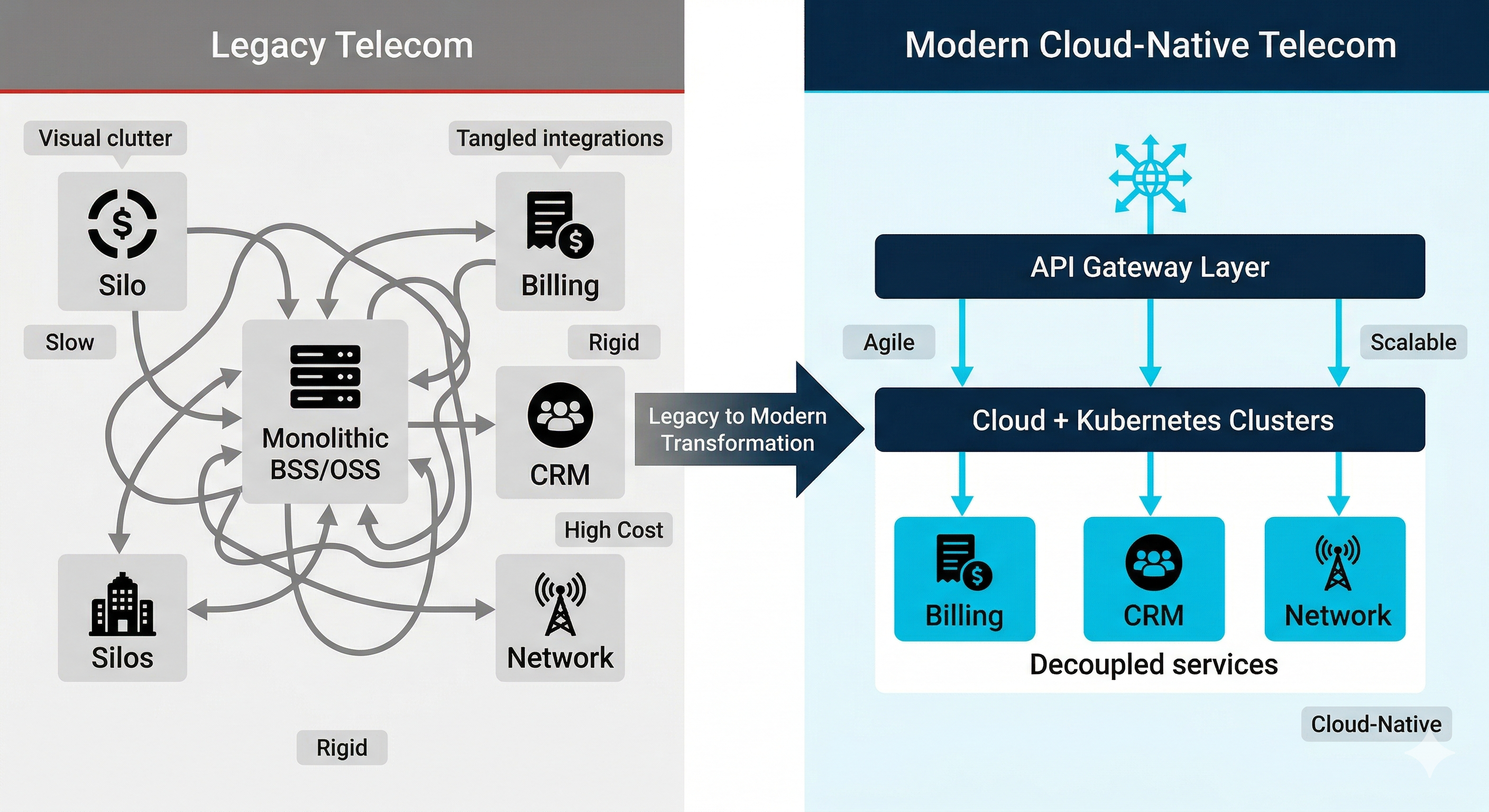
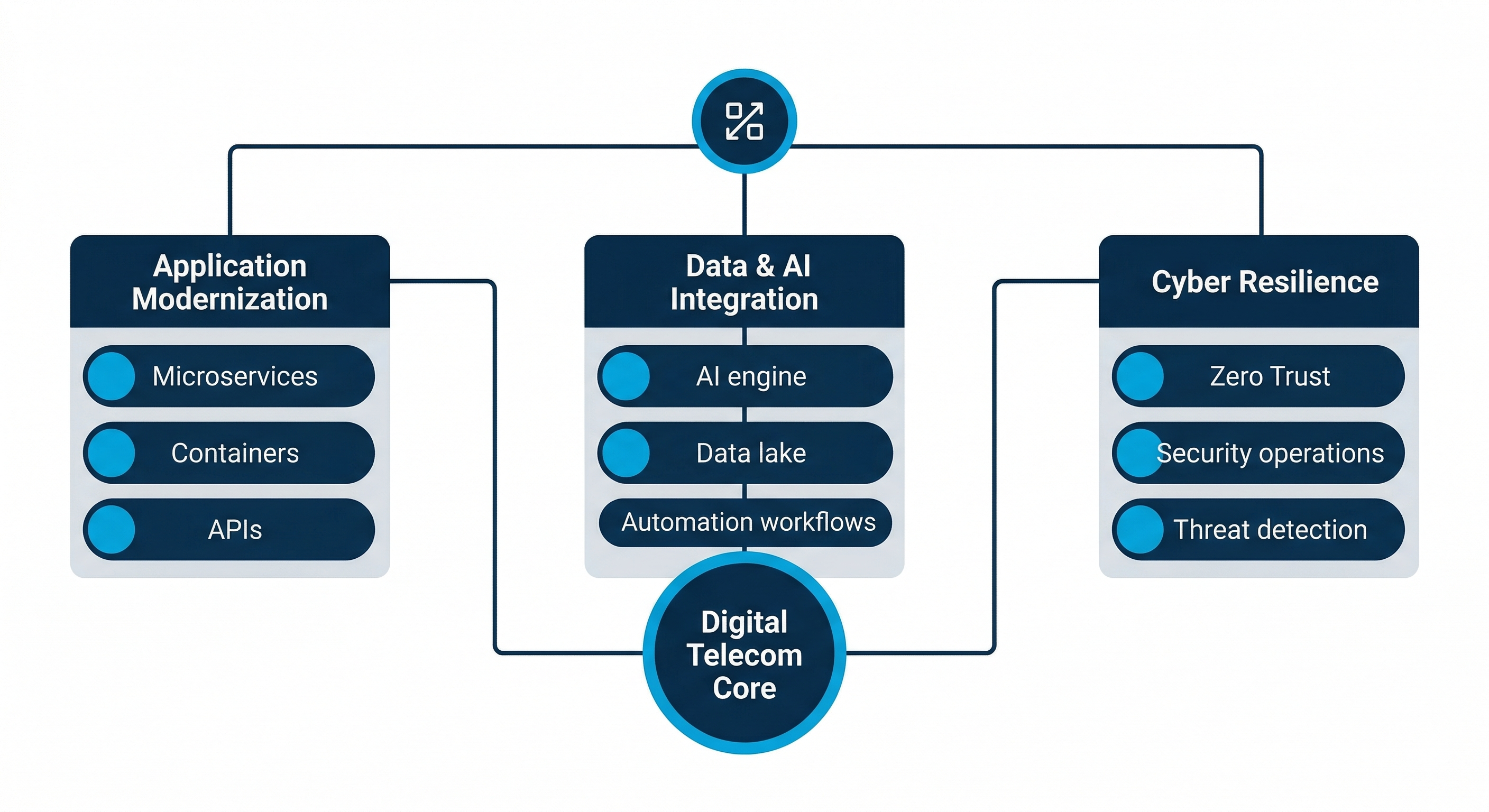
OptiValue Tek’s vision for the Future-State Telecom Architecture is built on the principles of modularity, autonomy, and intelligence.
SOAP monoliths → RESTful microservices on Kubernetes/OpenShift.
GenAI (JARVIS) automates ~70% workflows, improving processing.
AI-driven SOC, threat intelligence, and automated SOAR response.
Our recommended architecture utilizes a Multi-Region Hybrid Cloud approach, ensuring compliance with local data residency laws (GDPR/RBI) while maintaining global scalability.
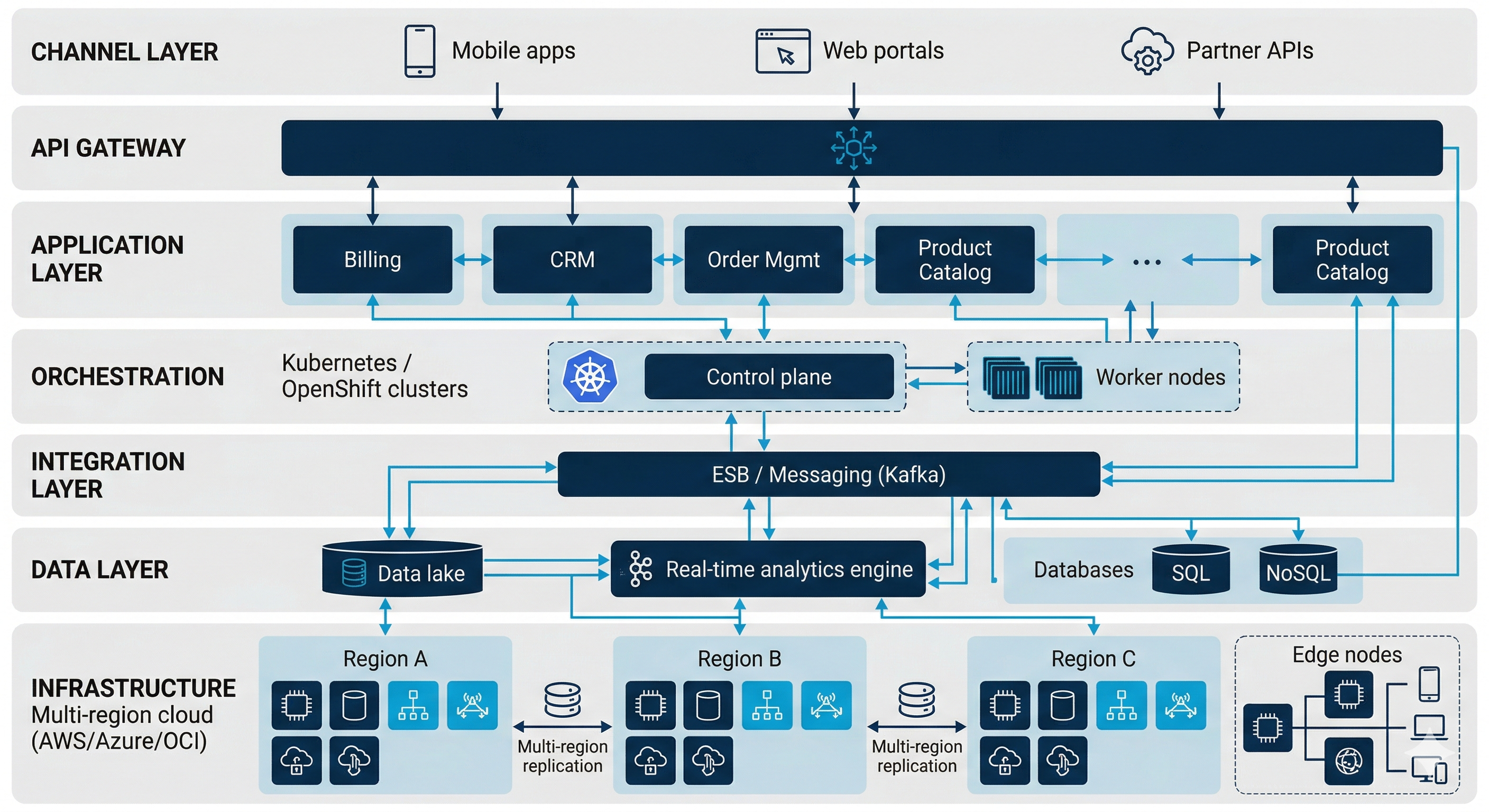
| Layer | Technology | Function |
|---|---|---|
| API Gateway | Apigee X / WSO2 | Secure, unified entry for 40+ channels. |
| Orchestration | Red Hat OpenShift | Enterprise-grade Kubernetes management. |
| Integration | Red Hat Fuse / MuleSoft | Legacy to Cloud data bridging. |
| Data Store | Snowflake / Oracle OCI | Real-time analytics and billing data. |
By decoupling the Front-end Engagement Layer from the Back-end Core Systems through an abstraction layer, we enable CSPs to update UI/UX without risking core billing stability.
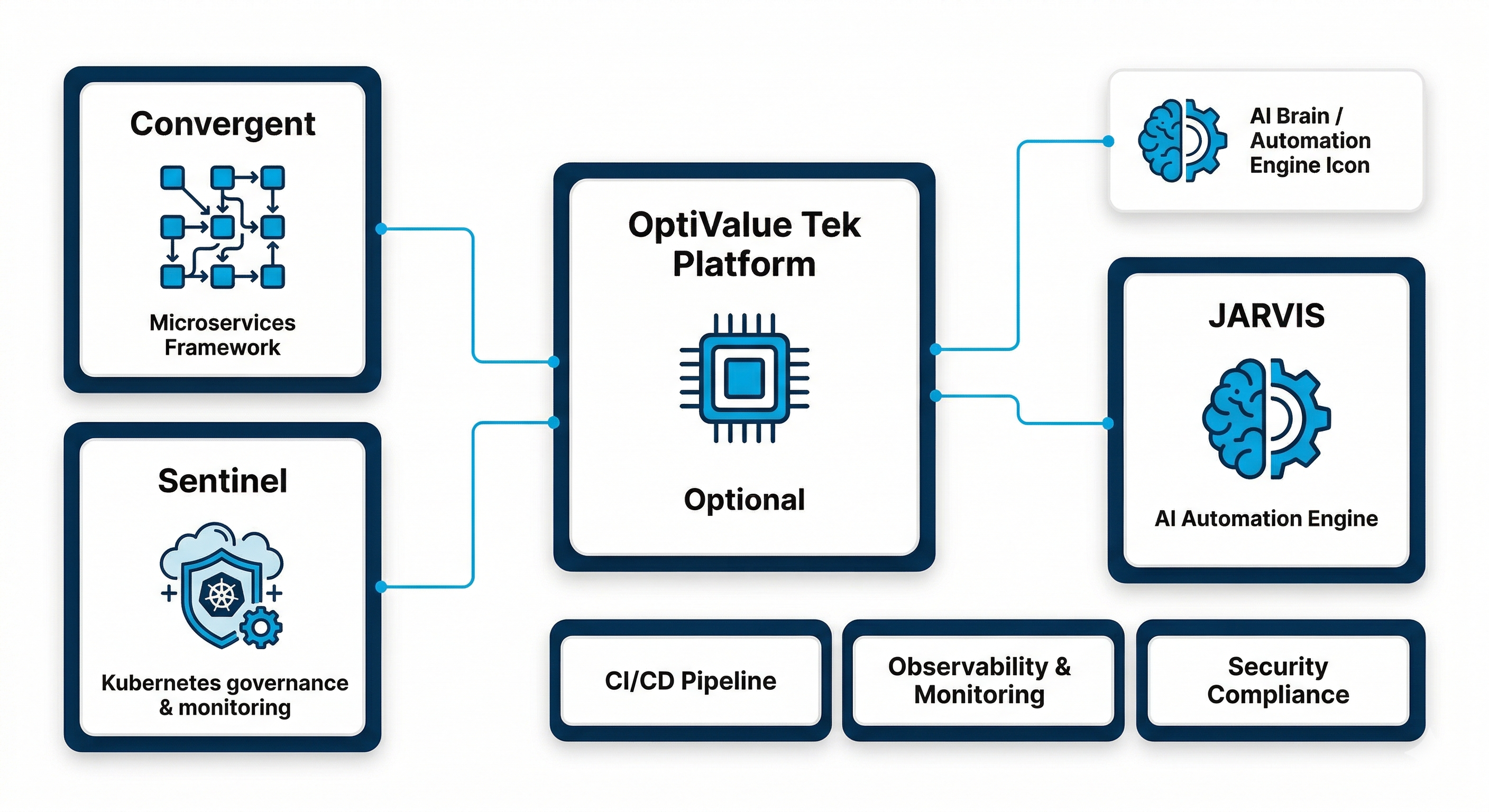
OptiValue Tek accelerates transformation using proprietary IP and pre-built frameworks.
We implement Site Reliability Engineering (SRE) practices to ensure "Five Nines" (99.999%) availability. This includes automated software patching, self-healing clusters, and proactive monitoring using Prometheus and Grafana.
Transformation is a marathon, not a sprint. We follow a four-phase methodology designed to minimize business disruption.
Assessment of the 2000+ existing integrations. Identification of "high-value, low-risk" candidates for initial migration.
Setting up the Cloud Landing Zone. Establishing the Global COE (Center of Excellence) and CI/CD pipelines.
Mass refactoring of SOAP services to REST. Lift-and-shift of VM workloads to OCI/AWS/Azure.
Integrating AIOps for predictive maintenance and automated customer support bots.
OptiValue Tek is uniquely positioned at the intersection of Enterprise IT Modernization and Next-Generation UAV Manufacturing.
Email: contact@optivaluetek.com | Web: www.optivaluetek.com
Offices: Bengaluru, India | Global Delivery Centers
Approved by:
Ashish Kumar, Director - Technical
Ragini Jha, Director - Operations